

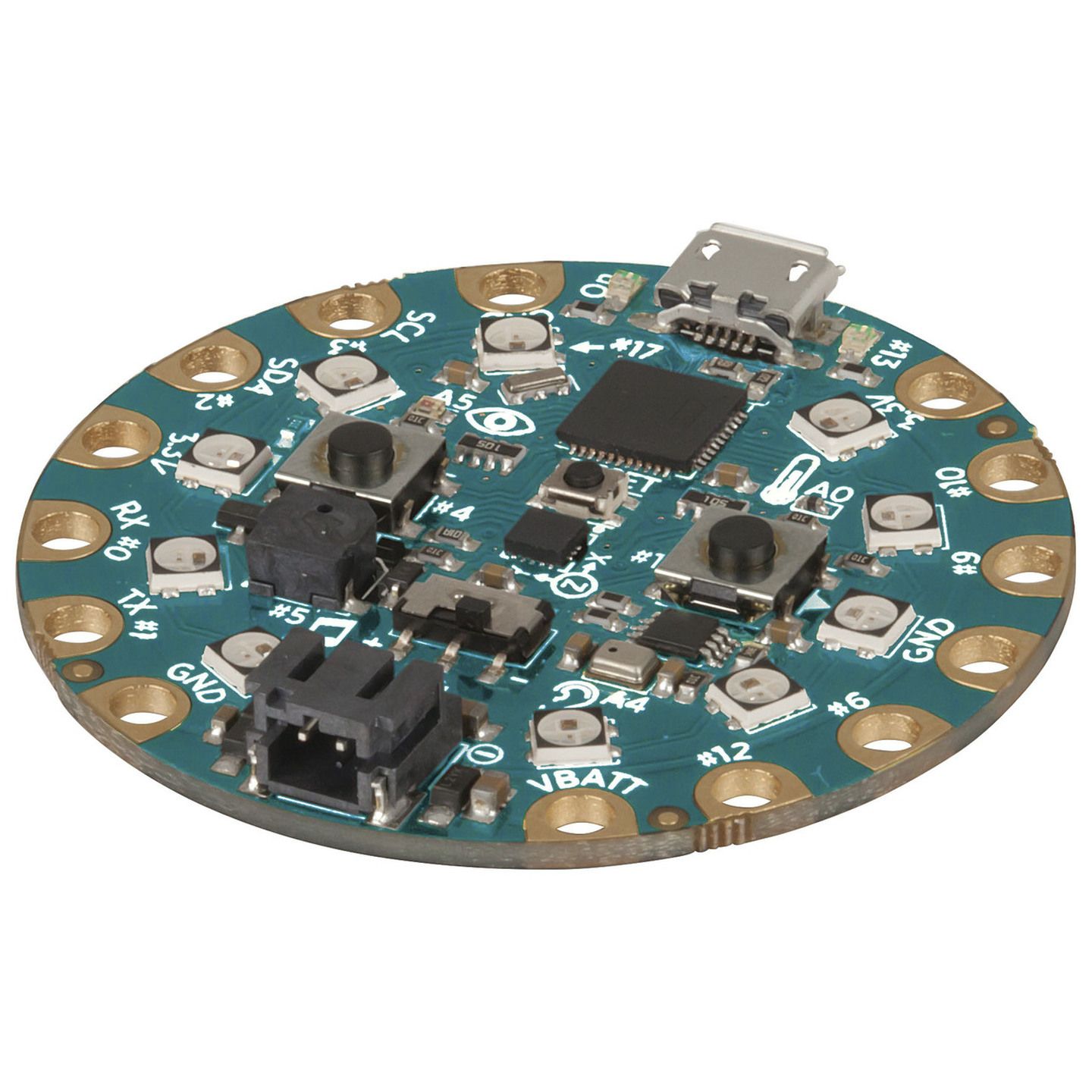

An all-in-one Arduino compatible board to add dazzling effects to your next project or costume. The round-shaped board features ten mini WS2812 individually addressable RGB LEDs, a motion sensor (accelerometer), temperature sensor (thermistor), light sensor (phototransistor), microphone, buzzer, left and right push-buttons, slide switch, and more to suit a wide variety of applications.
The fourteen power and I/O pads around the edge of the board are alligator clip friendly for prototyping purposes, can be soldered, mounted with metal screws, or sewn into your costume using conductive thread (sold separately). The onboard ATmega32u4 8-bit AVR microcontroller runs your Arduino code, and the eight I/O connections include Serial TX, Serial RX, I2C (SCL and SDA) and four GPIO pins. Program and power the board from USB or 3.3VDC. A battery pack (6V max.) can also be connected to make your project completely portable.
The USB port has HID support to act like a keyboard, mouse, joystick or MIDI, and the eight non-power related pads can be used as capacitive touch applications.
LEDs are compatible with Neopixel and FastLED libraries for example.
Duinotech Lilypad Plus Main Board
Customer Reviews

3.0
3 reviews
Verified purchases only.
Powered by Bazaarvoice.
Robust board - terrible documentation
Great product for your costume with lights type project. Documentation is terrible. There is zero documentation about the accelerometer, which seems not to work. The specs don’t even list what accelerometer chip is used, let alone where or how it is addressed, so plan to use an external accelerometer chip if you need this function. Otherwise cheap and cheerful. Perhaps there is built in charging control for a 3.7v pouch battery, but I’m speculating here.
confirmed the accelerometer part No
for the 1st reviewer I identified the part no, its an LIS3DH, Marking Code Breakdown is: xXYY: Date code, where "X" represents the year and "YY" the week of manufacture. C3H: Device identifier specific to the LIS3DH -- this is on the chip so confirms its model wwwww: Additional characters used for internal traceability purposes. datasheet is here: https://www.st.com/en/mems-and-sensors/lis3dh.html you are good to go now cheers Jeff
No bad board but badly identified and supported
Picked up two of these boards a few months ago, and honestly, the low price should’ve been a warning sign. As others have mentioned, the lack of documentation is pretty frustrating. The example sketch doesn’t even address or identifies the accelerometer which is a LIS3DH. Most of the information online assumes this component uses I²C but it doesn’t. It actually communicates over SPI on Pin 8. After some trial and error, I finally got it working. Sharing the compressed test code below for anyone who wants to skip the painful detective work. #include <SPI.h> #include "SparkFunLIS3DH.h" LIS3DH accel(SPI_MODE, 8); void setup() { Serial.begin(115200); while (!Serial); Serial.println("Starting LIS3DH in SPI mode..."); accel.settings.accelRange = 2; // ±2g accel.settings.accelSampleRate = 100; // 100 Hz if (accel.begin() != 0) { Serial.println("Error: LIS3DH not detected!"); while (1); } Serial.println("LIS3DH detected."); } void loop() { float x = accel.readFloatAccelX(); float y = accel.readFloatAccelY(); float z = accel.readFloatAccelZ(); Serial.print("X = "); Serial.print(x, 4); Serial.print(" Y = "); Serial.print(y, 4); Serial.print(" Z = "); Serial.println(z, 4); delay(200); }