

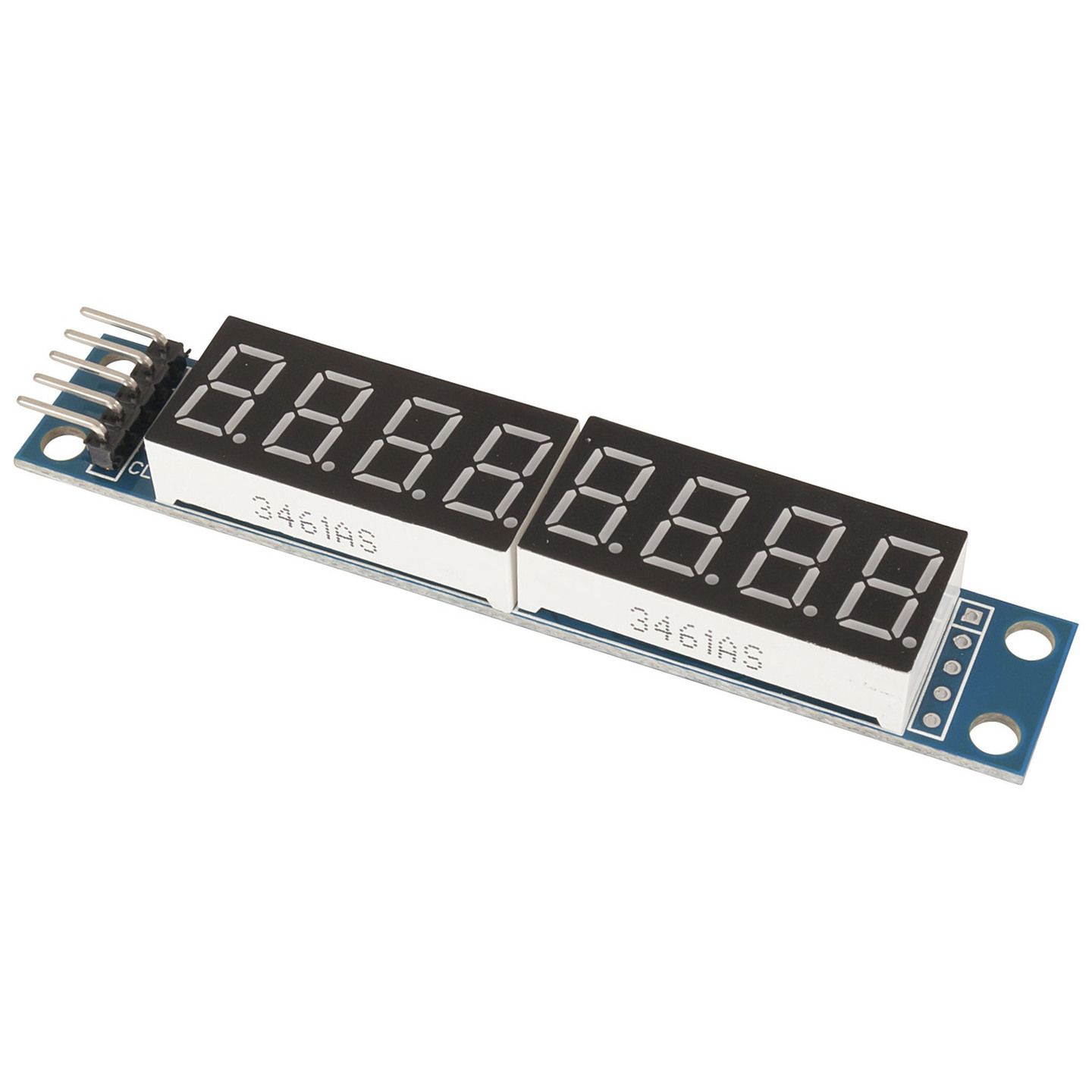


Technical Overview: YL-3 7-Segment Display
Introduction
The YL-3 7-segment display is a single-digit LED-based numeric display module. It features seven LED segments arranged in a figure-eight configuration and an eighth LED for the decimal point.
Each segment can be individually controlled to form numbers or simple characters.
Key Specifications
| Parameter | Value |
|---|---|
| Display Type | 7-segment LED |
| Configuration | Common Anode or Cathode |
| Number of Digits | 1 |
| Segment Voltage | 1.8V to 2.2V (typical) |
| Segment Current | 10-20mA per segment |
| Operating Temperature | -40°C to +85°C |
| Color | Red |
| Mounting Type | Through-hole |
Physical Characteristics
- Dimensions: 15mm panel height with red 9mm digits
- Material: Plastic encapsulated housing with opaque lens.
- Pin Count: SPI interface
Pinout Description
| Pin | Function |
|---|---|
| 1 | Segment 'a' |
| 2 | Segment 'b' |
| 3 | Segment 'c' |
| 4 | Segment 'd' |
| 5 | Segment 'e' |
| 6 | Segment 'f' |
| 7 | Segment 'g' |
| 8 | Decimal Point (DP) |
| 9, 10 | Common Anode or Cathode |
Operating Principles
The YL-3 7-segment display operates by illuminating specific LED segments to form numbers or basic alphanumeric characters. For example:
- To display the digit "1," segments b and c are activated.
- To display the digit "8," all segments (a to g) are illuminated.
A current-limiting resistor is required in series with each segment to prevent overcurrent damage, typically with values of 220Ω to 330Ω.
Electrical Characteristics
- Forward Voltage (Vf): 1.8V to 2.2V per segment.
- Forward Current (If): 10-20mA per segment.
- Reverse Voltage: Up to 5V.
- Power Dissipation: ~0.2W per segment.
Applications
- Digital clocks
- Timers
- Counters
- Digital meters (voltage, current, etc.)
- DIY and STEM educational projects
Driving the YL-3 Display
The YL-3 display can be driven using the following methods:
- Direct Microcontroller Pins:
- Each segment connects to a GPIO pin.
- Suitable for simple applications.
- Driver ICs:
- MAX7219 for efficient control.
- Reduces GPIO pin usage.
- Multiplexing:
- Allows control of multiple digits with fewer pins.
Advantages
- Low cost and widely available.
- Easy integration with standard circuits.
- Bright and legible output.
Limitations
- Limited to numeric or basic alphanumeric displays.
- Higher power consumption compared to modern display technologies like LCD or OLED.
- Requires additional components (resistors, drivers) for operation.
Conclusion
The YL-3 7-segment display is a versatile, cost-effective solution for numerical data visualization in a wide range of applications. Its simplicity and robust operation make it an ideal choice for hobbyists, educators, and basic industrial uses.
Arduino Compatible 8-Digit 7-Segment Display
Customer Reviews

1.2
5 reviews
Verified purchases only.
Powered by Bazaarvoice.
Wrong part - works differently. Not suitable.
Part does not match description. Code examples do not work. Data sheets are for the wrong part. It looks like the original part used the MAX7219 , the one in the box uses the 74HC595 which is a simple shift register. The original worked by loading the value into the display and it was displayed. The current one requires you to continuously multiplex the display to show anything other than a random 2 digits. Wasted too much time trying to work out what was wrong.
Nice but not the same as the ones I bought before
I bought another version of this under the same part number from Jaycar, and I have printed boards made to suit it. When I wanted some more, I found that the size of the board and the hole dimensions were different from the original ones. Now I have a bunch of PC boards that I can't use. I also found that the new unit uses 74HC595 chips instead of the original MAX7219. These are different items. While they might be 'compatible', the depicted items differ from those sold to me, and it is irksome, mainly because of the time spent so far on this little project.
Wrong product, pointlessly swapping components
Jaycar needs to get there stuff together. Brought this in store and both the box and the system says its the max7219, there was even a message that popped up on the screen asking if i wanted to "upgrade" to the 74HC595 and i declined. However when i opened the box it was not working and i found that i have the 74HC595 and know i cant get anything working. I dont even know why they swapped the max7219 out for the 74HC595, who on earth needs multiplexing for a 7 segment dispaly? Build quality is mediocre noting special. Value of the product is terrible considering this is false advertisement.
The 2x4 digit display depth of despair
I just this today 30 Dec 25 and thinking it would be the MAX chip but found it is the shift register version. The software code has chinese script and uses "Keil uvision plus C51". Names of files are in chinese script and needed to use google translate. No schematic but had to search on line through "MAX..." & "74HC595..." Box states MAX7219.....! but it is a "SM74HC595D" version. PCB has chinese script also no english.
Buy something else
I had a previous iteration of this product, which worked. The new version does not work with any common segment display libraries.