

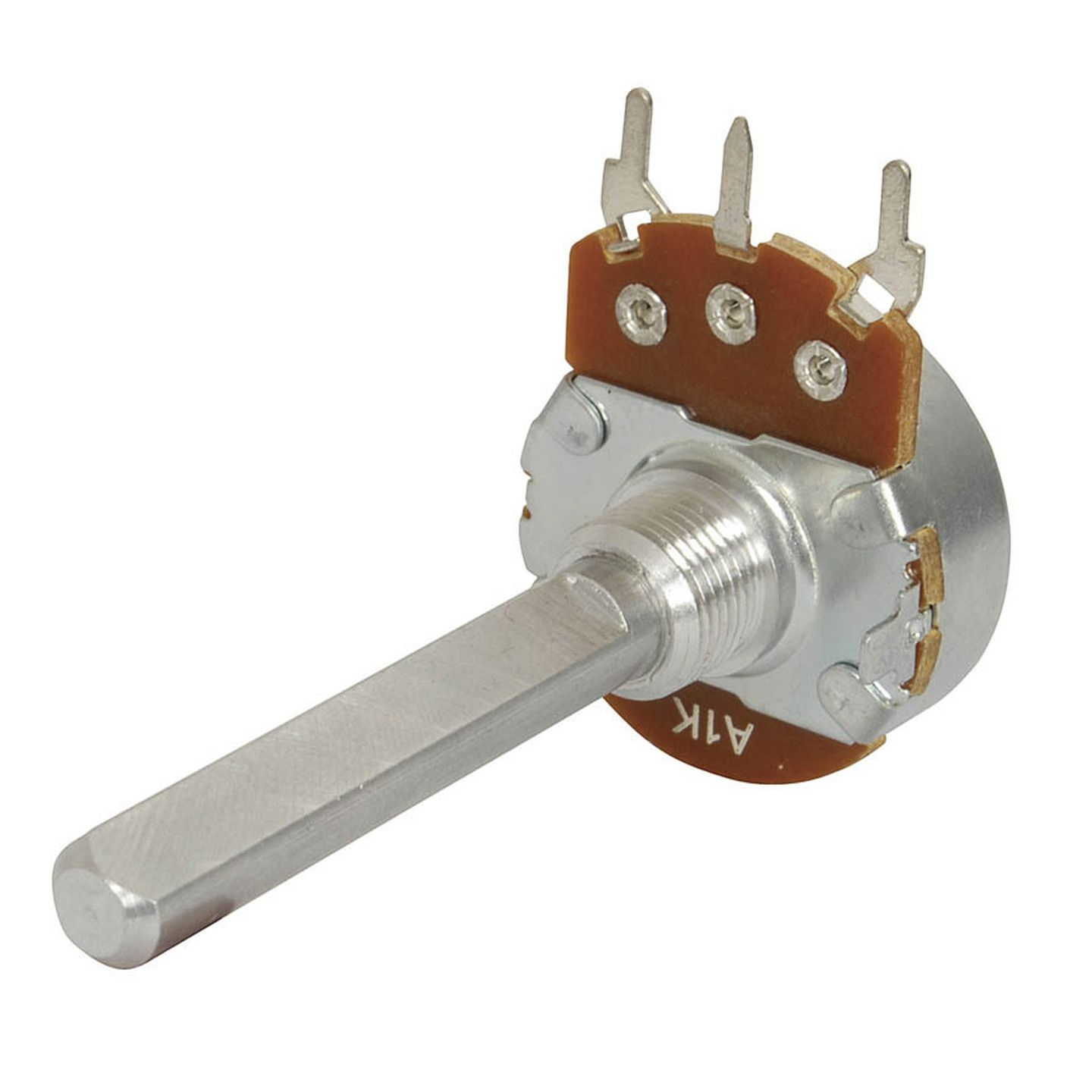
With imperial standard shaft & bushings made to our rigid engineering specifications. The potentiometers are full size - 24mm diameter types . Power rating is 0.5W max. They have genuine 6.35mm (1/4) shafts with a flat machined 25% of the diameter for grubscrews or interference fit knob mounting. The shaft is a generous 38mm long. The bush is a 3/8 32 T.H.D. type which we believe is necessary for good fixing to a panel. Another important feature of the pots is their PCB mount capability. The pins are rigidly mounted on phenolic with the centre pin offset from the two outer terminals. When soldered into a PCB, the pot is quite rigidly held on its own. Double gangpots are held in 6 places and require no extra mechanical mounting assistance. The pins are large enough to terminate screened cable, etc., if the job requires hard wiring. Value100K
100k Ohm Logarithmic (A) Single Gang 24mm Potentiometer
Customer Reviews

1.0
1 review
Verified purchases only.
Powered by Bazaarvoice.
Incorrect product description
I have now purchased 4 of these. 2 from Jaycar Springvale and 2 from Frankston. They are 10k dual gang pots as stated, However they are not linear! I rang the branch and spoke to one of the 'techsperts' after the first 2 didn't perform as intended. He didn't really know what I was saying and suggested I buy 2 more from another Jaycar store, incase there was a batch of wrongly labelled pots around. I did this, but the next 2 which are also labelled linear, and have different appearance, still behave in a logarithmic manner. At a loss as to why the product is described as linear but is clearly logarithmic!